Service 01 . 40 min . A3
The comprehensive exam.
Forty minutes with an optometrist. You leave with a prescription, a read on your eye health, and the photos to prove it.
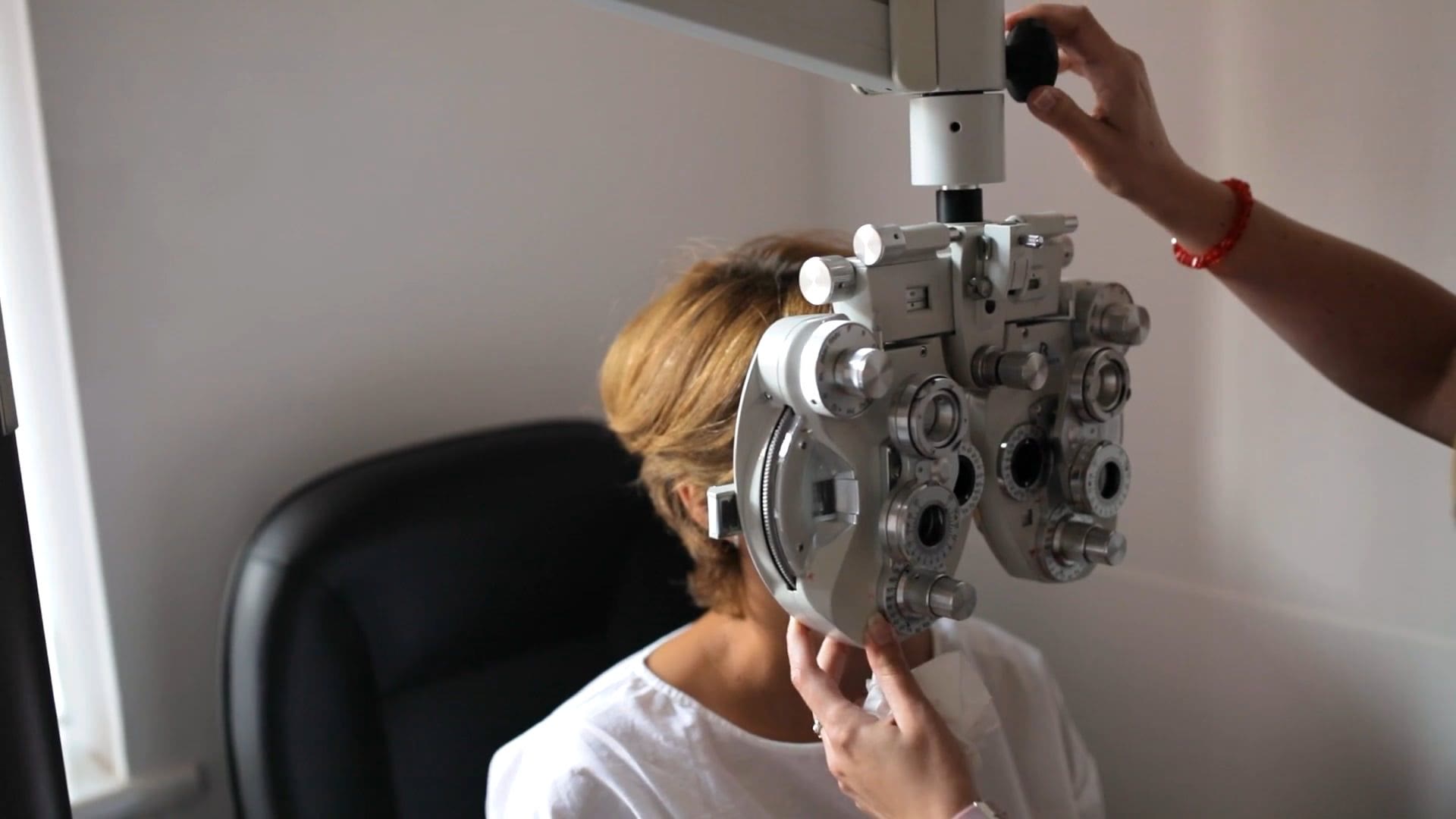
What happens in forty minutes.
- 00:00 to 05:00
History
What bugs you, what you do all day, medications, family history. Screen hours count. This is where most of the clues are.
- 05:00 to 12:00
Pretesting
Pressure check, a map of your current glasses, and an auto reading of your prescription as a starting point.
- 12:00 to 24:00
Refraction
The "one or two" part, on the phoropter. We go slowly. There is no wrong answer, and you can ask to see them again.
- 24:00 to 34:00
Eye health
Slit lamp for the front of the eye, then the retina by photo or dilation. We check for glaucoma, cataract, macular change and diabetes signs.
- 34:00 to 40:00
The talk
What changed, what it means and what we would do. You get your prescription in hand either way. Buying glasses here is optional.
Dilation, or a photo for $39.
To see the back of your eye we either widen your pupils with drops, or take a wide retinal photo. Drops mean blurry close vision and light sensitivity for three or four hours. The photo takes a minute and you can drive straight after.
Retinal imaging adds $39. Some people still need dilation: diabetes, high myopia, flashes and floaters, or something odd on the photo. The doctor will say why.
A visual field test adds $41 when your history calls for it, like glaucoma in the family.
How often to come back.
| Who | How often |
|---|---|
| Kids and teens | Every year |
| Adults 18 to 39, no problems | Every 2 years |
| Adults 40 to 64 | Every 1 to 2 years |
| 65 and over | Every year |
| Contact lens wearers, diabetes, glaucoma risk | Every year |
The price
Returning patient $135. New patient $160. Retinal imaging +$39, visual field +$41. Range $135 to $240.
Vision plans usually cover the exam. How that works.
Wear contacts? Add a contact lens fitting. Bringing a child? Book a kids exam back to back with yours. Then book the exam.